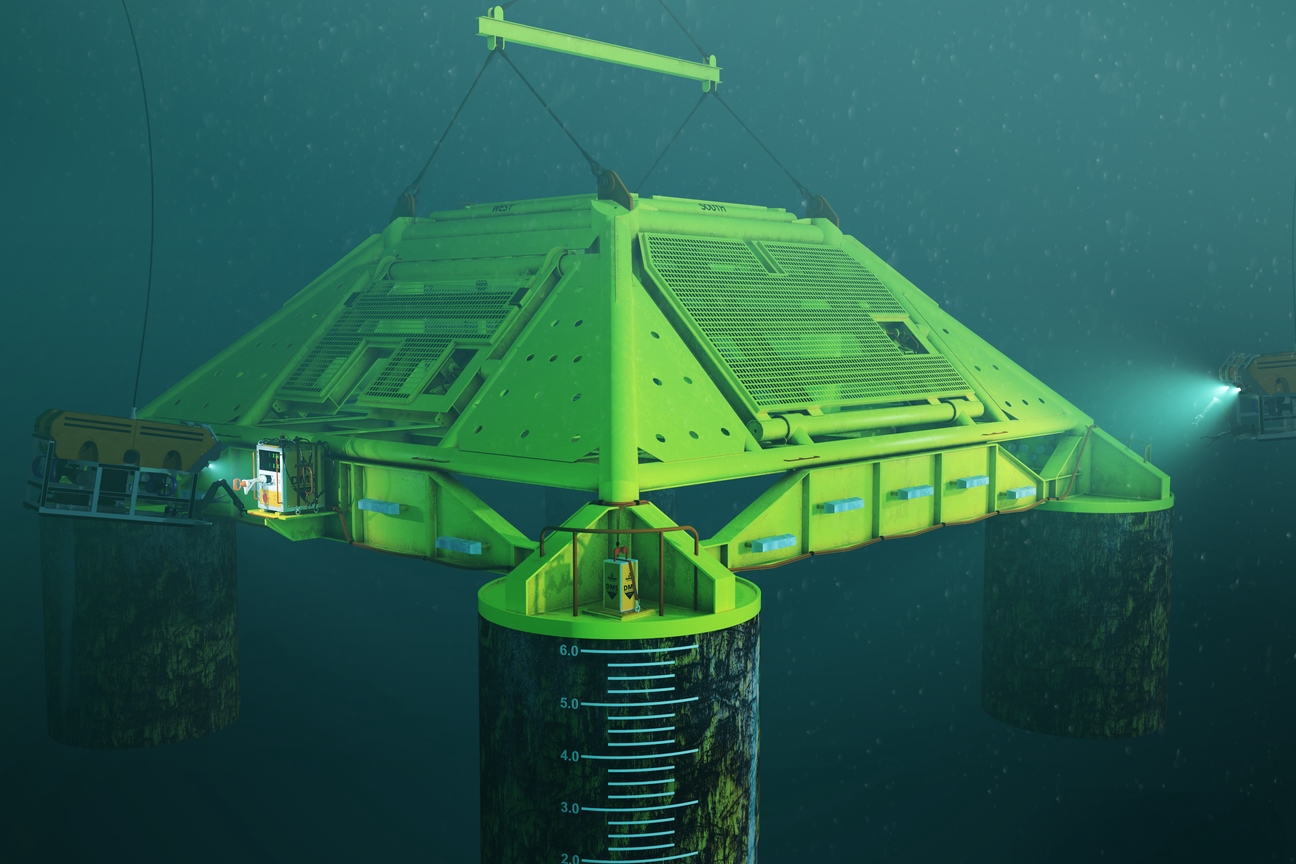
Precision Under Pressure: Delivering Accuracy in Offshore Construction
The offshore industry has evolved rapidly, with modern installation projects demanding exact coordinates, headings, inclinations and depths. Even minor misalignments can result in costly rework, project delays or structural stress.
Advanced monitoring solutions support the preparation, installation and integrity of offshore energy infrastructure. From traditional oil and gas developments to the growing offshore renewables sector, this technology ensures projects are delivered safely, efficiently and with confidence.
The tools behind the precision
Over the past 30 years, installation monitoring systems have evolved significantly. Today’s integrated systems are lighter, more power efficient and make more data available to engineers. Fibre Optic Gyros and high accuracy MEMS motion sensors have made the acquisition of heading, attitude and pitch and roll measurements possible in the most demanding environments. Specialist laboratories, like Ashtead Technology’s calibration facility in Klepp Stasjon, ensure the reliability and accuracy of these systems.
Attitude Monitoring Systems (AMS), Installation Monitoring Systems (IMS) and Deflection Monitoring Systems (DMS) have become essential. With the option of advanced technology batteries to provide autonomy, and connected by high-speed optical or acoustic communications, these systems provide near real-time visibility on the movement and orientation of critical structures.
Ashtead Technology’s DMS for example, can integrate external sensor data such as suction anchor pressure, giving engineers actionable, real-time information during installation. By tracking twist, deflection and vibration, these systems help reduce mechanical stress and mitigate risk.
Specialised system integrators are pushing the boundaries of integration, combining subsea cameras, GNSS receivers, AHRS, altimeters and next-generation data modems into streamlined, bespoke systems. Whether it’s for jacket positioning or pile template monitoring and large-diameter drilling, these solutions enable smarter decision-making and faster operations.
As an example, Ashtead Technology was approached by a major operator in the UK North Sea looking for a bespoke hammered pile installation monitoring system. The project scope demanded a high precision and robust integrated attitude monitoring system with power management and subsea digital data logging. The solution was a custom designed and built integrated monitoring system, that used a range of monitoring sensors and integrated monitoring software for maximum operational versatility. This integrated precision monitoring package met extreme shock loading requirements and utilised a unique measurement method to generate accurate measurements of the template’s attitude, in combination with acoustic positioning.
Field-proven innovation
These technologies have enabled success in some of the world’s most challenging offshore environments. A laser / LIDAR -based IMS for instance, delivers non-contact, shock-resistant measurements ideal for high-precision topside and monopile installation. Other projects have relied on ultra-compact, man-portable monitoring units capable of delivering real-time structural data from the seabed to the surface.
An example of the LIDAR system in use was for the installation of an offshore substation (OSS) topside which would conventionally be positioned with GPS, Gyro, a radio modem and batteries. These would need to be dimensionally controlled and require personnel on the structure.
Ashtead Technology’s partner, Pliant Offshore, utilised a laser/LIDAR based IMS system to track the OSS in real time, with no sensors required on the structure. Outputs were position, heading and inclination. The IMS saved significant vessel time during installation, did not require personnel on the OSS, reducing risk to personnel, and removed the requirement for dimensional control reducing overall project cost.
Across all deployments, the goal remains the same: provide safe, reliable, high-resolution data to reduce installation risk, avoid costly rework and ensure long-term performance.
Future-focused capabilities
Offshore structures are becoming larger, more complex and more interconnected – demanding smarter, leaner and more accurate monitoring solutions. Vessel uptime is imperative. Accuracy remains critical. Efficiency is key.
Technology is making that possible. With remote operations, automated measurement, high-speed wireless data transfer and compact, precision sensors, the industry is better equipped to execute projects with confidence than ever before.